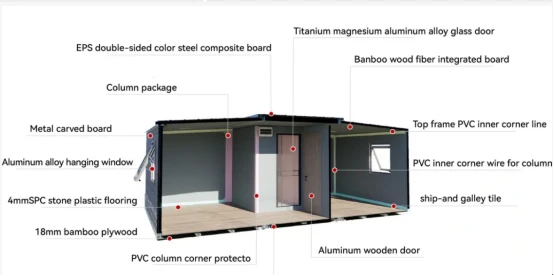
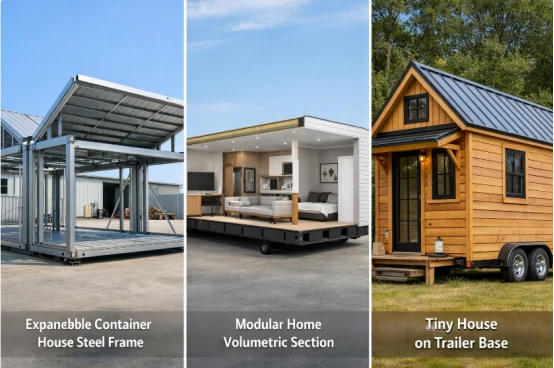
Not all expandable container houses are built the same — and most problems start before shipping
When buyers search for an expandable container house manufacturer, they often compare price, layout, or delivery time. But experienced distributors know the real difference is hidden much earlier — inside the production line.
By the time a unit reaches your site, most of its performance has already been decided in the factory.
If the production system isn’t standardized, no amount of installation experience can fix what was never controlled to begin with.
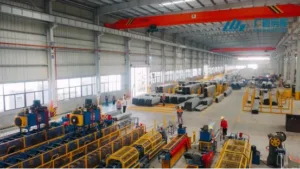
Why the Production Line Matters More Than the Product Itself
An expandable container house is not a static commodity. It’s a repeatable mechanical product that must open, close, seal, and perform the same way hundreds of times across different climates and project conditions.
That level of reliability doesn’t come from drawings.
It comes from how the factory organizes steel processing, assembly tolerance, sealing methods, and testing procedures.
A professional expandable container house factory runs less like a construction yard and more like a light industrial manufacturing line. Every step exists to remove uncertainty — because distributors don’t just buy one unit. They commit to long-term project supply.
What Happens When Production Is Not Standardized
Many buyers only discover production weaknesses after deployment. Typical issues include:
Units that expand smoothly in the sample but require adjustment on site
Roof sealing that works in mild climates but fails under tropical rain
Structural frames showing variation between batches
Installation teams spending extra hours correcting alignment
These are not design flaws. They are production consistency problems.
In this industry, reliability isn’t about how one unit looks — it’s about whether the hundredth unit behaves exactly the same as the first.
Most project failures don’t come from design — they come from inconsistency between batches.
Inside a Real Expandable Container Production Line
Understanding what a top expandable container production line actually looks like helps distributors separate scalable manufacturers from workshop-style suppliers.
1.Steel Frame Processing: Precision Before Assembly
The structure defines whether repeated deployment is possible.
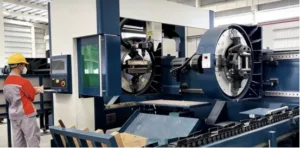
High-quality factories rely on controlled cutting, forming, and galvanization processes to ensure dimensional accuracy before components ever reach assembly.
If tolerances drift here, expansion mechanisms will never align consistently later.
2.Modular Fabrication Instead of Piece-by-Piece Construction
A mature expandable container manufacturer treats wall panels, roof systems, and folding sections as standardized modules rather than building each unit like a custom project.
This approach allows repeatable fabrication instead of improvisation.
For distributors, that means predictable lead times, stable specifications, and easier inventory planning.
3.Mechanical Integration That Anticipates Repeated Use
Expandable units must endure multiple deployment cycles — not just one installation.
That requires precise alignment of sliding structures, hinges, and reinforcement points so the unit performs the same way after transport, relocation, and reinstallation.
Factories experienced in project supply design these systems for lifecycle performance, not just delivery condition.
4.Weatherproofing Designed for Global Deployment
Expandable housing is often used in mining camps, infrastructure projects, and temporary accommodation across very different environments.
Sealing methods, drainage paths, and insulation layers must be engineered during manufacturing, not improvised during installation.
This is where a factory turns assembled parts into a building that can survive real-world conditions.
5.Controlled Interior Integration
Electrical layouts, insulation placement, and interior finishes are installed within a defined workflow rather than added after structural assembly.
So when the unit arrives, installers aren’t starting from an empty shell.
They’re connecting systems that were already positioned and tested under factory conditions — which dramatically reduces uncertainty on site.
6.Real Operational Simulation — Not Just Visual Inspection
In a mature expandable container production line, units are actually opened, adjusted, and checked before shipping.
This is less about appearance and more about behavior.
Does it unfold smoothly? Do the locking points align? Do the seals compress correctly?
These are the same questions your installation crew would ask — just answered earlier, where they’re easier to control.
7.Repeatability Testing Across Batches
Scalable manufacturers judge quality across multiple units, not just a single finished sample.
Consistency between batches is what allows distributors to supply projects months or years apart without redesign, re-measuring, or retraining installation teams.
A true production line proves itself through repetition.
How Distributors Can Evaluate an Expandable Container House Factory
When visiting or auditing a supplier, focus less on showroom samples and more on process clarity.
Ask questions like:
Where is dimensional accuracy controlled during fabrication?
Are modules produced through repeatable workflows or manual fitting?
How are expansion mechanisms verified before shipment?
Is testing documented across batches?
Can the manufacturer support wholesale supply with consistent specifications?
A real expandable container house factory should be able to explain its production system step by step — not just present a finished unit.
If a factory cannot clearly show where precision is controlled, where repetition is ensured, and where problems are caught before shipment, then what you are seeing is not a production line — it’s a workshop scaled up for export.
The Role of Manufacturing Discipline in Long-Term Project Supply
Distributors and contractors are not only purchasing structures; they are building supply chains.
That’s why manufacturing discipline — material control, standardized assembly, and pre-delivery verification — matters more than short-term customization.
At GS Housing, the GS Housing production line is built around standardized workflows, full-process quality control, international compliance requirements, and stable large-scale capacity. The focus is not just to manufacture units, but to ensure every unit performs predictably across different projects and timelines.
Factories that invest in structured production tend to support partners with:
Stable lead times for bulk orders
Predictable installation performance across regions
Reduced after-sales adjustment
Easier technical coordination for future phases
These advantages rarely appear in a quotation sheet, but they define long-term cooperation.
Choosing a Manufacturer Is Really Choosing a Production System
The expandable container house market continues to grow because it offers speed, mobility, and scalable modular housing solutions.
But those advantages only materialize when the manufacturing behind the product is engineered for repetition.
For distributors, dealers, and project contractors, evaluating the production line is the most reliable way to judge whether a supplier can support real-world deployment — not just deliver a sample.
Because in modular construction, success is not decided on installation day.
It’s decided long before, on the factory floor where consistency is built into every unit.
That’s why experienced distributors evaluate the factory first — and the product second.