If you’re comparing expandable container house vs modular home, you’re not choosing a building type.
You’re deciding how your capital will behave over the next 3–10 years.
Will your housing units:
Start generating value within days?
Move with your next contract?
Or remain fixed assets tied to one location?
In 2026, prefab selection isn’t about trend. It’s about risk allocation.
For EPC contractors, developers, distributors, construction camp operators and government planners, this is a capital structure decision disguised as a housing discussion.
Why Expandable Container House vs Modular Home Matters More in 2026
Land use cycles are shorter.
Project rotations are faster.
Cash flow sensitivity is higher.
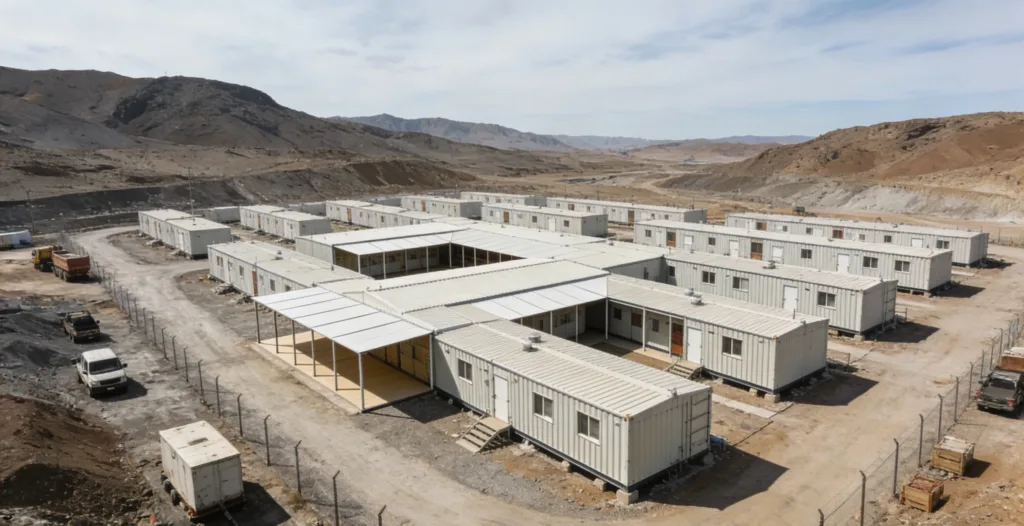
Temporary housing, mining camps, infrastructure support bases — these sectors now demand mobility and deployment speed more than ever.
At the same time, residential development still values permanence and mortgage eligibility.
The market hasn’t chosen one winner.
It has split into two clear financial models:
1.Mobility-driven ROI
2.Permanence-driven ROI
Understanding which model you operate in changes everything.
Three Real-World Scenarios: Expandable Container House vs Modular Home in Action
Let’s remove technical language and look at how each system performs under pressure.
Scenario 1: Expandable Container House for Construction Camp (30-Day Launch)
Your project has already started.
Workers arrive next month.
The land lease expires in two years.
You need:
Minimal site preparation
Fast deployment
Relocation capability
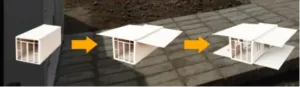
An expandable container house for construction camp arrives folded, unfolds on-site within hours, connects to utilities quickly, and becomes operational almost immediately.
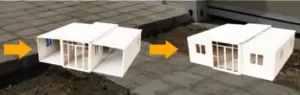
Two years later?
You move it.
That redeployment cycle is the core driver behind the ROI of container homes in temporary projects.
A modular home cannot replicate this asset mobility.
Scenario 2: Modular Home for Permanent Residential Development
You’re building a suburban housing community.
Buyers need:
Mortgage approval
Permanent foundations
Long-term appreciation
Here, modular homes function like traditional real estate once installed.
The ROI depends on resale value and land appreciation — not relocation.
Mobility has little relevance.
Permanence becomes the financial logic.
Scenario 3: Tiny House for Boutique Tourism & Lifestyle Projects
You are developing ten architecturally distinct rental units near a scenic location.
Scale is small.
Branding matters.
Guest experience drives pricing power.
Tiny houses often perform well in this niche because their value is emotional and experiential — not industrial.
But scalability is limited.
They are not built for 200-unit rapid deployment across rotating contracts.
Different model. Different math.
Structural Philosophy: Container Housing vs Prefab Homes
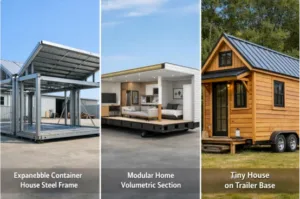
The difference in container housing vs prefab homes isn’t cosmetic.
It’s structural intention.
Expandable Container House
Steel-framed system engineered for transport efficiency
Designed for repeated folding, unfolding and relocation
Optimized for temporary housing, labor camps, mining sites and emergency deployment
Modular Home
Factory-built volumetric sections
Permanently assembled on prepared foundations
Functions as long-term residential real estate
Tiny House
Compact design often placed on trailers or light foundations
Lifestyle-oriented
Limited batch scalability
Structure determines financial behavior.
ROI Comparison: Expandable Container House vs Modular Home vs Tiny House
For commercial users, ROI is measured by:
Speed to operation
Infrastructure investment
Reuse cycles
Asset mobility
Multi-project lifespan
Here’s a simplified operational comparison:
| Factor | Expandable Container House | Modular Home | Tiny House |
| Initial Unit Cost | Competitive | Higher | Mid-range |
| Foundation Requirement | Minimal | Full permanent | Varies |
| Deployment Speed | 1–2 days | Several weeks | Variable |
| Relocation Capability | High | Extremely limited | Limited |
| Batch Scalability | Excellent | Moderate | Low |
| Best Application | Construction camps / temporary housing | Permanent residential | Boutique tourism |
In a 200-unit camp model serving 24-month contracts, an expandable container system may generate income across multiple project cycles.

A permanently installed modular home generally does not.
That single difference often outweighs upfront cost comparisons.
Market Direction: Best Temporary Housing Solution 2026
In 2026, large-scale infrastructure and energy projects increasingly prioritize:
Lower capital lock-in
Faster setup timelines
Reduced stranded asset risk
Transport efficiency
This is why expandable container systems are widely considered a leading solution for temporary housing and rotating project bases.
Modular homes remain dominant in permanent residential sectors.
The two are not competing.
They are serving different financial logics.
Decision Framework: Choose Expandable Container House, Modular Home or Tiny House
Before choosing, answer these internally:
1.Is land use temporary or permanent?
2.Will relocation likely occur within 3–5 years?
3.Does deployment speed directly affect revenue timing?
4.Do you prioritize reuse value or resale appreciation?
If flexibility, relocation, and rapid startup drive your model, expandable systems align naturally.
If permanence and property appreciation drive your strategy, modular homes are structurally appropriate.
If branding and experiential differentiation define your product, tiny houses may fit better.
Final Perspective
There is no universal winner in prefab housing.
There are only aligned and misaligned decisions.
Expandable container houses protect ROI in mobility-driven projects.
Modular homes support value growth in permanent developments.
Tiny houses support niche lifestyle positioning.
In modern modular construction, your housing system is not just shelter.
It is an asset strategy.
And the wrong structure can quietly erode returns long before the project ends.
FAQ
1.Which option is most commonly usedfor construction camps in 2026?
Expandable container houses are widely used due to deployment speed and high relocation value.
2.How should ROI of container homes be calculated?
Include initial investment, transport cost, operational expenses, redeployment cycles, and total income generated across multiple projects.
3.Are modular homes less profitable?
Not necessarily. They perform well in permanent residential developments tied to long-term real estate value.
If you are evaluating expandable container house systems for rotating or temporary projects, working with a manufacturer that understands transport efficiency, reuse cycles, and capital allocation can significantly reduce long-term risk.
As an experienced expandable container house manufacturer, GS Housing approaches project discussions from a capital efficiency and relocation planning perspective.
For technical specifications or case references, you may visit our homepage or contact our team for direct evaluation support.