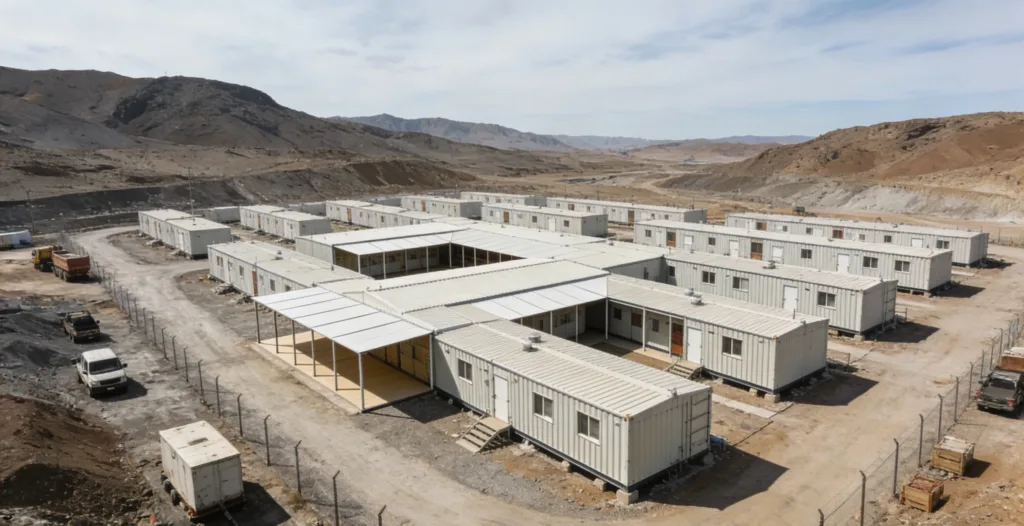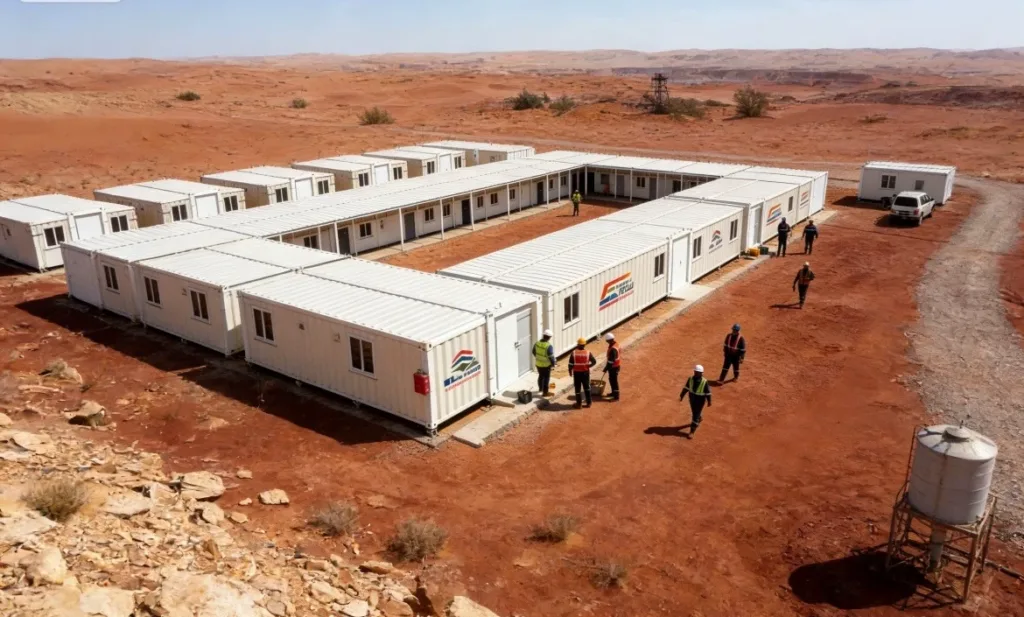
When natural disasters strike or military teams need to deploy fast, government agencies face immediate pressure to stand up safe, functional temporary housing.For these critical scenarios, expandable container homes for government have emerged as a proven, fit-for-purpose solution.
Relief crews need shelters that go up in hours. Military units need livable accommodation for short-term missions. Every step has to follow rigid procurement rules, while staying locked into pre-approved budget lines.
Traditional construction almost never keeps up. Permanent builds take weeks or months, demand heavy site work, and far too often leave empty facilities that can’t be repurposed once the mission or relief effort wraps.
That’s why a growing number of government and military teams now turn to expandable container homes as their go-to temporary shelter solution.
Government Emergency Housing Needs for Expandable Container Homes
Government and military teams don’t shop for temporary housing the way private companies do.
Every choice has to align with strict global standards, stick to fiscal year timelines, avoid public pushback, and ensure no unnecessary long-term infrastructure is left behind when operations end.
These aren’t extra hoops to jump through—they’re the baseline for any public-sector emergency project.
Public procurement teams also work under layers of strict oversight. Every purchase needs full documentation, clear cost justification, and alignment with long-term public asset rules.
There’s almost no room for late deliveries, inconsistent quality, or solutions that fall short of international emergency response benchmarks.
Unique Challenges Facing Government & Military Emergency Housing
Compliance & Funding Approval for Government Emergency Shelter
Funding and compliance are almost always the first hurdles to clear.
Shelters for disaster relief, military housing, or emergency response must match guidelines from FEMA programs, EU emergency frameworks, or UN disaster relief standards.
Units that miss these marks can hold up funding approvals, or force teams to jump through extra documentation hoops—time they simply don’t have in a crisis.
This is why most agencies favor pre-engineered housing systems for government emergency housing that already align with emergency housing requirements. They streamline procurement reviews, and let disaster or operational funds be released far faster.
Fiscal Timing and Public Pressure
Government budgets run on strict fiscal timelines. Temporary housing projects have to move fast to hit approval windows tied to annual allocations or emergency funding.
In some cases, projects lose their entire budget simply because construction timelines drag too long.
Then there’s public expectation. In disaster zones, slow housing deployment is impossible to hide. Communities waiting for shelter expect a rapid response—and poor or delayed arrangements can quickly spark public criticism and media attention, creating real political risk for the agencies in charge.
For government teams, every day of housing delays adds to an already heavy operational burden.
Long-Term Asset Responsibility
The work doesn’t stop when the emergency phase ends.
Permanent structures built during recovery often sit unused once operations shift. Maintaining or tearing them down can turn into an unplanned, costly liability.
In some regions, environmental restoration rules can push post-project expenses even higher.
For public agencies focused on responsible resource management, temporary housing that can be moved or reused is far easier to justify than fixed infrastructure that becomes a stranded asset.
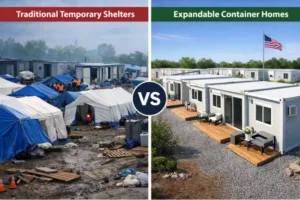
How Expandable Container Homes Solve Government Emergency Housing Challenges
On-site conditions for emergency and military teams are rarely predictable.
Disaster zones have next to no construction capacity. Field bases can’t wait weeks for permanent builds. Expandable container homes are made for exactly these messy, time-sensitive scenarios.
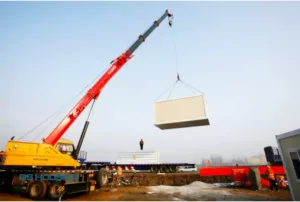
All units are prefabricated in factories, and arrive on site in folded, compact packages. No complex foundations or heavy land leveling required. Teams can unfold and set them up directly.
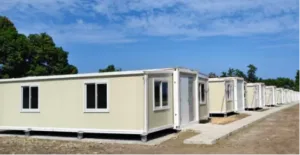
A full shelter area can be ready in just a few days. Housing can be in place while water, power and roads are still being repaired. This matches the realistic, stop-start pace of emergency response work.
These units use reinforced steel frames, paired with weatherproof and insulated wall panels. They stand up to strong winds and heavy rain in harsh environments, and deliver safe, dignified living conditions for displaced residents and deployed military personnel.
Best of all, they can be folded and moved again once the mission ends. No abandoned buildings left behind. No extra cost for demolition or site cleanup. This fully fits the compliance and asset management rules for public agencies.
Speed and Logistics in Emergency Deployment
When you’re in an emergency, logistics and speed make or break the entire response.
Remote disaster zones often have narrow roads and limited transport. Field military bases are far from urban supply chains.
Traditional prefabricated buildings take up too much space. A single truck can carry only a few units, making fast delivery to frontline areas nearly impossible.
Expandable container homes fix this. They fold into a small footprint, so each truck can carry far more units than traditional solutions. This cuts down the number of trips, eases logistics pressure, and gets units to remote, hard-to-access areas much faster.
Emergency sites and military bases also rarely have large construction crews and heavy equipment on hand. These units don’t need complex tools or professional builders. On-site staff can finish assembly quickly, with no need to wait for outside construction support. This removes the biggest logistical barriers to fast housing deployment.
Cost Efficiency and Flexible Deployment
Budget control is non-negotiable for public agencies, and expandable container housing fits perfectly within tight fiscal limits.
Authorities can deploy units in stages, based on real-time operational demand—no need to build out full capacity upfront, when needs are still shifting.
Agencies can scale housing up or down step by step, matching capacity to what’s actually required on the ground.
The compact transport design also cuts shipping costs and simplifies logistics planning. Over time, reusing the same units across multiple missions or projects drives significant long-term cost savings for public budgets.
Real-World Applications in Government and Military Operations
Expandable container housing has proven its value across a range of real public-sector operations.
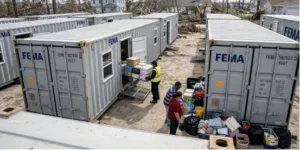
Following a major coastal hurricane in the U.S., a state emergency management agency used FEMA disaster relief funds to deploy more than 300 expandable container homes for displaced residents. Procurement approval took less than a week—well within the fiscal year’s funding window—and the shelters were fully operational in under a week. Compared to traditional temporary building options, the project cut overall costs by roughly a third, and shaved nearly two-thirds off the construction timeline.
Local emergency officials noted: “This solution let us move fast when it mattered most, stay within our funding guidelines, and avoid the kind of public pressure that comes with slow relief efforts.”
In Europe, a national defense ministry needed temporary housing for personnel rotating through multiple training locations. Rather than building permanent structures at each site— which would have meant repeated construction costs and eventual demolition—they used expandable container homes funded through their annual infrastructure budget. Approval took less than a week. Units were deployed, used, then folded and moved to the next training base when exercises ended. Across three sites, the same housing served missions that would otherwise have required separate, one-off builds. Ministry logistics teams estimated savings in the millions—funds that stayed in their budget, instead of going to demolition and repeat construction costs.
FAQ
1.Are expandable container homes compliant with government emergency housing standards?
Yes. These units are engineered to meet baseline structural safety rules, and can be tweaked to fit FEMA, EU, or UN emergency housing frameworks.
Regional specs will vary, but the base build aligns with the standards most government and military projects require.
2.How quickly can expandable container homes be deployed in disaster zones?
Units ship folded to save space and speed up delivery. On site, a small crew can get a single unit fully set up in a few hours.
For larger deployments, that means full shelter sites can be up and running in days, not the weeks traditional builds take.
3.Can expandable container homes be reused after disaster relief operations?
Absolutely. This is one of the biggest wins for public sector teams.
Units fold down easily, so you can ship them to a new site, redeploy for the next relief mission, training exercise, or temporary project. No wasted build, no stranded assets—just infrastructure that works for you across multiple uses.
Why Expandable Container Homes Fit Government Emergency Housing Needs
For government agencies and military planners, emergency housing is never just about getting roofs up fast. It’s about checking every box: meeting compliance rules, hitting funding timelines, and not leaving costly, unused buildings behind when the mission wraps.
Expandable container homes do all this without extra hassle. They deploy fast when a crisis hits, keep procurement and logistics simple, and fold up easily when the work is done—ready to go again for the next mission.
That mix of speed when it matters, flexibility across uses, and accountability to public budgets? It’s exactly what modern emergency housing programs need.