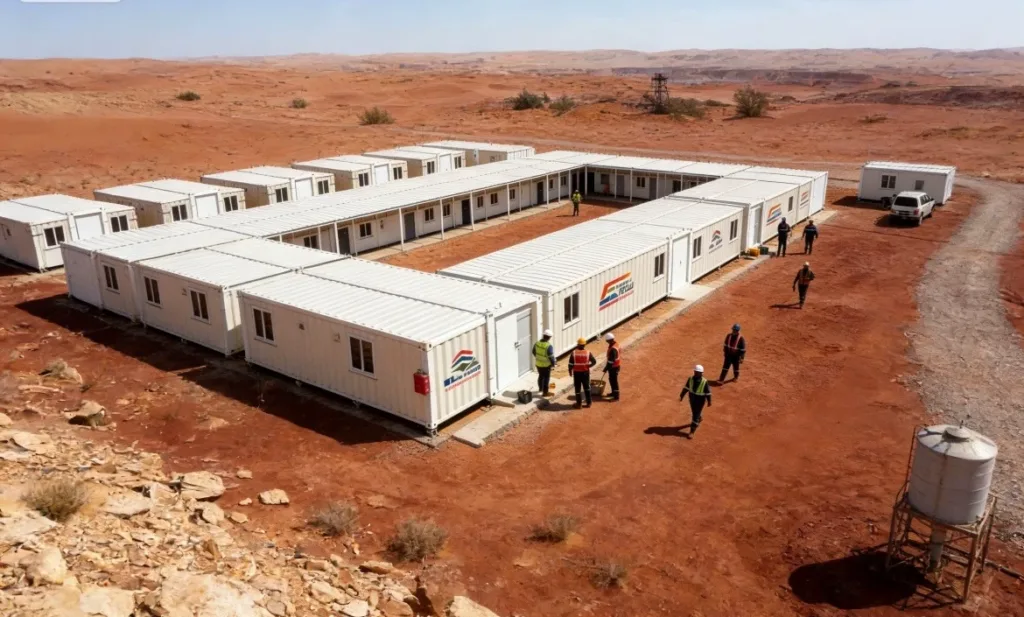
If you’ve ever tried to build worker housing for a remote mining site, you already know the problem: getting accommodation ready on time is often harder than building the mine itself. For remote mining projects across South America, reliable, on-time mining camp housing is the single biggest make-or-break factor for hitting your production timeline. Every day your worker camp accommodation sits incomplete, you burn tens of thousands in lost production revenue. That’s why modular mining camp setups are now the industry standard across the continent, replacing the delays and cost overruns of traditional on-site construction.
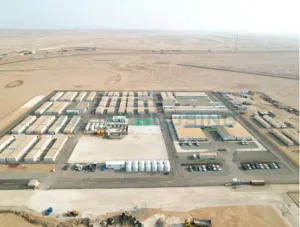
Traditional builds take 6+ months in these remote regions, with every material and tradesperson traveling hundreds of kilometers over rough, unpaved roads. You face constant weather delays, sky-high transport costs, and the risk of missing critical production start dates. Expandable container houses fix these headaches, built explicitly for South American mining’s unique logistical realities.
For project budgeting, see our full guide to expandable container house cost in South America for transparent, up-to-date pricing.
3 Core Challenges of Remote Mining Camp Housing
Isolation of Mining Locations
South America’s richest mineral deposits sit far from urban centers: the average Atacama copper mine is 320km from the nearest major city, with almost no local construction labor or paved access. Building permanent structures here is often logistically unfeasible, making consistent worker camp accommodation a constant operational headache.
Sky-High Construction Costs
Trucking a ton of cement into the Atacama costs 7x more than dropping it in Santiago, and mobilizing a 50-person build crew means housing, feeding, and insuring them for 6+ months on top of hourly wages. These costs spiral quickly, driving more operators to modular housing for mining camps to cut avoidable expenses.
Project-Derailing Delays
If your mining camp housing isn’t ready on schedule, your entire operation can’t launch. Delays trigger lost revenue, government penalty fees, and missed production windows. For large mines, housing must be fully operational before extraction can begin—full stop.
Why Expandable Container Houses Are Ideal for Mining Camp Housing
The biggest win of these units isn’t just speed—it’s eliminating the uncertainty that plagues remote builds. Take a 2024 project we completed in Vanuatu, for example: the client needed a small, fully functional camp for staff accommodation and on-site project management, on a remote island with almost no local building supplies and a humid climate that makes traditional construction a nightmare.
We built the entire camp with a mix of 20ft and 30ft expandable container units. The 20ft modules became staff living quarters, each with a full bathroom and compact kitchenette, while the larger 30ft units were set up as on-site offices, meeting rooms, and a dedicated project operations hub. Every part of the build—electrical wiring, insulation, doors, windows—was finished and tested in our factory before shipping. On site, each unit unfolded and locked into place in just a few hours, with no complex construction required.
For the client, the biggest win wasn’t just the fast timeline—it was total predictability. Instead of 6+ months of on-site headaches, supply delays, and weather hold-ups, they could focus on their core project, not camp construction. This is exactly what makes these units such a perfect fit for remote South American mining operations: they strip out the chaos of building in isolated locations.
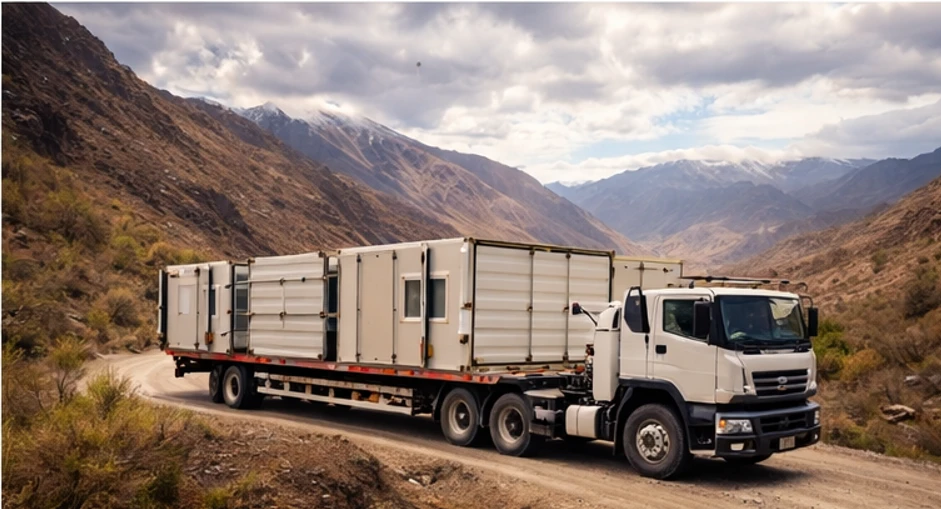
Beyond that, their foldable design solves remote transport nightmares: 4+ fully finished units fit into one standard shipping container, cutting the number of trucks needed by 80% vs traditional builds. They navigate narrow mountain and desert roads full-size construction trucks can’t, with no heavy cranes or specialized equipment needed for installation.
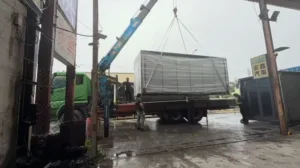
They’re also built for mining’s harsh realities: heavy-duty galvanized steel frames stand up to 100km/h winds, constant dust, and corrosion, while high-performance insulated panels regulate temperatures in 40°C+ desert heat and freezing highland nights. This cuts energy costs and reduces worker turnover by up to 20% vs basic temporary huts. Finally, they’re fully scalable: add or remove units in days as your workforce shifts, with no major reconstruction needed.
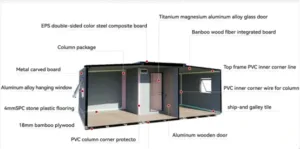
Typical Modular Mining Camp Layout
A well-designed modular mining camp is laid out for 24/7 shift work, not just a generic grid of units. The main entrance anchors an administrative zone with private offices and meeting rooms, while quiet dormitory clusters (the core of your worker camp accommodation) sit within 150 meters of round-the-clock dining halls, pre-plumbed sanitation units, and laundry facilities, with lit walkways and noise buffers for off-shift workers.
Expandable Container Mining Camps Across South America
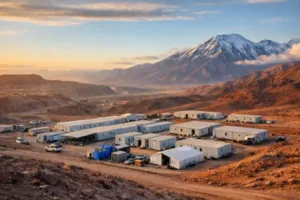
Over the past few years, we’ve seen more and more mining projects across South America turning to modular housing solutions. In Chile’s Atacama Desert, they’re the only practical way to launch camps 300+km from urban centers, avoiding the massive cost of mobilizing full construction crews across the desert. In Peru’s high Andes, construction seasons can be short due to weather. Prefabricated housing allows teams to install accommodation quickly during those narrow windows, with minimal on-site work needed before weather worsens. In parts of Brazil where mining sites are spread across remote areas, they let teams scale housing up and down as production shifts, with fully reusable units that can move between multiple sites over 8+ years.
Frequently Asked Questions (FAQ)
What is modular mining camp housing?
At its core, modular mining camp housing is prefabricated, container-based accommodation built for workers in remote mining areas. Every unit is fully finished in a factory, shipped compactly, and set up in hours, with no need for full on-site construction.
Why are expandable container houses perfect for mining camps?
They solve mining’s 3 biggest headaches: ultra-fast deployment, easy transport to even the most remote sites, and seamless scaling as your workforce changes, with none of the cost or delays of traditional builds.
How long does it take to install a modular mining camp?
Most small-to-medium modular mining camp setups are fully operational in days to weeks—up to 80% faster than traditional construction, which takes 6+ months for the same size camp.
Can modular housing withstand harsh mining environments?
Yes. High-quality units use heavy-duty galvanized steel frames and weather-resistant insulated panels, built to stand up to extreme temperatures, high winds, dust, and heavy daily use for years.
Conclusion
At the end of the day, remote South American mining comes with enough unavoidable unknowns: volatile commodity prices, shifting regulations, unpredictable weather, and complex logistics. You’ve got enough on your plate managing the mine itself—your mining camp housing shouldn’t be another source of stress.
Expandable container houses take the guesswork out of camp builds, delivering reliable, flexible worker camp accommodation that fits your timeline and budget. For teams across Chile, Peru, and Brazil, modular mining camp solutions aren’t just a convenient alternative to traditional builds—they’re a smarter, more predictable way to get your project up and running on time.
If you’re tired of fighting the endless headaches of remote camp construction, the GS Housing team is here to share site-specific insights tailored to your operation.