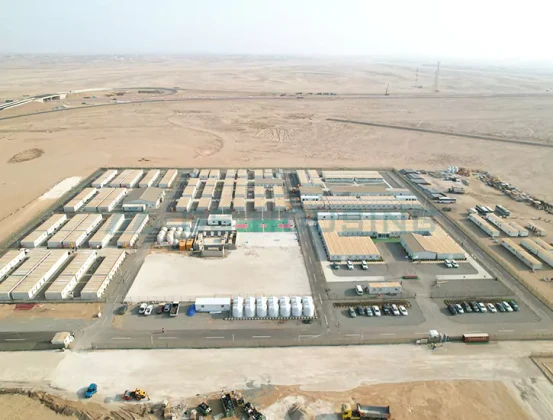
If you’re evaluating expandable container house durability for a remote project, the first question we get from every client, before we even talk specs, is always the same:
How long is this actually going to last?
Not the number in a brochure.
Not a lab test result.
But out there — in real conditions.
Under desert heat. Coastal salt spray. Long-distance transport. Daily use, non-stop.
After 20+ years working with expandable container systems at GS Housing, we’ve seen what actually holds up — and what doesn’t:
In real projects, expandable container house durability is often what ultimately determines whether a unit performs well over time.
Durability doesn’t come from one feature.
It comes from how the structure, materials, and protection systems work together.
And in many cases, when something fails early, it’s not random — it’s because one of those layers wasn’t designed for the actual environment.
What Determines Expandable Container House Durability (Steel, Panels, Floor Explained)
On paper, most units look similar:
Steel frame
Sandwich panels
Modular layout
But in real projects, the difference between a unit that lasts 15–20 years and one that starts failing in 3–5 years usually comes down to three systems:
Galvanized steel frame (structural backbone)
Sandwich panels (insulation + fire safety)
Floor system (load-bearing + durability)
In remote camps, it’s rarely one big failure.
More often, it’s small issues — corrosion, moisture, deformation — building up over time.
Galvanized Steel Frame Specs: What Affects Structural Durability
Below is the general structural breakdown of our dual-wing expandable units (core frame logic is consistent across 20ft, 30ft, and 40ft models):
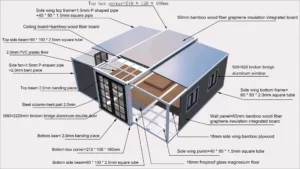
This structural layout shows how load-bearing components are distributed across the expandable frame system.
For most projects, we use Q235B steel structure for our galvanized steel frame container units, as it balances strength, flexibility, and cost in a practical way.
For a standard 40ft expandable container house, typical specs look like this:
Top side beam: 80×140×3.75mm galvanized rectangular tube
Bottom side beam: 80×140×3.0mm galvanized rectangular tube
Columns and end beams: 3.0mm formed steel
These numbers matter more than they might seem at first.
A 3.0mm frame doesn’t just “look stronger” — it tends to perform differently over time:
Less deformation during lifting
Better resistance to transport stress
More stability under stacking and wind load
In projects involving frequent relocation or harsher climates, these differences usually become noticeable after repeated use.Over time, these factors play a key role in overall expandable container house durability.
Hot-Dip vs Cold Galvanizing: Impact on Expandable Container House Durability
Almost every supplier will describe their structure as “galvanized.”
But in practice, that can refer to very different processes.
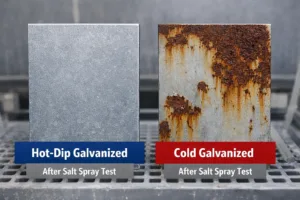
Here’s what that difference actually looks like in real testing conditions:
Hot-dip galvanized steel typically shows significantly better corrosion resistance than cold galvanized steel under salt spray testing conditions.
How hot-dip galvanizing works
In a hot-dip process, steel components are immersed in molten zinc at around 450°C.
This creates a bonded layer between zinc and steel, rather than just a surface coating.
The protection mainly comes from what’s often called a sacrificial mechanism:
Zinc corrodes first
Steel remains protected underneath
Minor surface damage doesn’t immediately lead to rust
Under standard testing conditions (such as ASTM B117 salt spray tests), properly treated components can typically withstand extended exposure before visible corrosion appears.
Practical differences in real projects
From what we’ve observed across different sites:
Hot-dip galvanizing
Zinc coating: typically ≥100 g/m²
Service life: ~15–20 years (normal conditions)
Better performance in coastal or high-humidity environments
Cold galvanizing (spray or electroplating)
Thinner coating
Limited bonding to steel
May show earlier signs of corrosion in harsh conditions
In some projects, an additional powder coating layer is applied on top, especially for coastal or industrial environments.
Rockwool vs Glass Wool: Best Insulation for Container Houses
Below are our standard fireproof sandwich panels for expandable container houses, built with double-sided galvanized steel sheets and high-density insulation core — the key component of fire safety, thermal comfort, and long-term material durability.
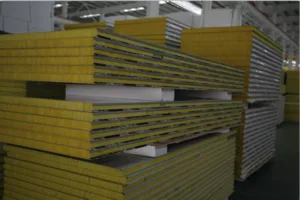
The wall and roof system, defined by fireproof sandwich panel specs, plays a bigger role than just enclosure. It directly affects:
Fire safety
Indoor comfort
Long-term durability
A typical configuration might include:
50mm sandwich panels (1150 type)
Double-sided 0.35mm steel sheets
External 0.45mm roof sheet
But the core material inside the panel is what makes the real difference.
Rockwool vs glass wool (performance comparison)
In most projects, we work with two types of insulation: rockwool and glass wool.
Rockwool (basalt-based)
Density: ~100–120 kg/m³
Fire rating: A1 (non-combustible)
Thermal performance: stable (R-value ~1.2–1.3 for 50mm)
Moisture behavior: generally water-repellent
Glass wool
Density: ~48–64 kg/m³
Fire rating: typically A2
Thermal performance: slightly lower at same thickness
Moisture behavior: can absorb water over time
For worker camps or long-term use in demanding environments, rockwool is generally preferred.
Glass wool may still be suitable for short-term or dry-climate applications.
MGO Board vs Plywood: Best Flooring for Container Houses
The floor is often overlooked — until issues start to appear.
In high-use environments, it takes continuous stress from:
Foot traffic
Equipment loads
Moisture exposure
A typical system includes:
18mm MGO board (main structure)
18mm bamboo plywood (expandable sections)
1.6mm PVC surface layer
Why MGO board is often used in long-term projects
Compared with common alternatives:
MGO board (magnesium oxide board)
Load capacity: ~350 kg/m²
Fire rating: A1
Strong resistance to moisture
Suitable for long-term, high-traffic use
Plywood / OSB
Lower load capacity (~150 kg/m²)
More sensitive to moisture
More prone to deformation over time
Standard fiber cement board
Moderate strength (~250 kg/m²)
Fire-resistant
Can be more brittle under impact
In practice, flooring issues tend to develop gradually rather than suddenly.
How Climate Affects Expandable Container House Durability
One common misconception is that a single configuration works everywhere.
In reality, specifications are often adjusted based on environment:
Coastal regions → higher corrosion protection
Cold climates → thicker insulation, thermal breaks
High wind zones → reinforced structure
Tropical humidity → moisture control + ventilation
One factor that is sometimes underestimated:
Container house drainage design (we’ve broken down the full waterproofing system details here)
Water accumulation — inside the frame, under flooring, or on the roof — is a common contributor to long-term issues.
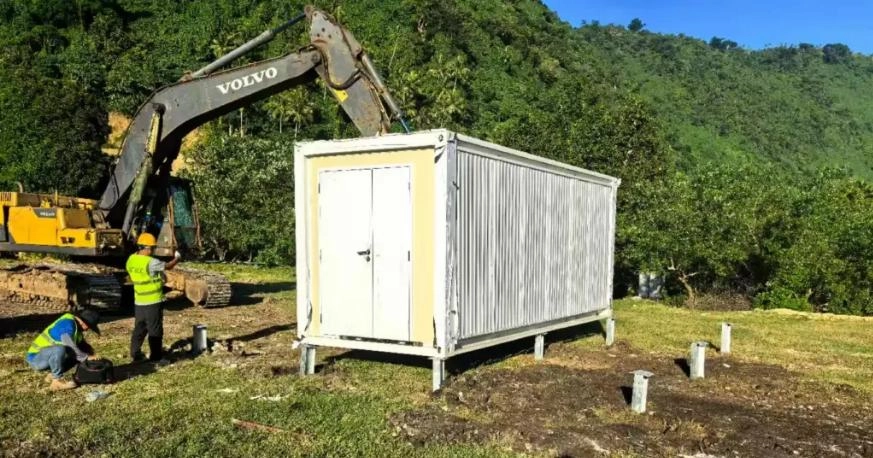
Real Project Case: Vanuatu Expandable Container Camp

In a coastal project in Vanuatu, we supplied an expandable container camp for a remote infrastructure team.
The environment included:
High humidity
Constant salt-laden air
Frequent heavy rainfall
During early planning, there was consideration to simplify the anti-corrosion system to reduce cost — something that often comes up in coastal projects.
The final configuration included:
Full hot-dip galvanized structure
Additional powder coating
Rockwool A1 insulation panels
Enhanced drainage detailing
After several years of use, the structures have remained stable, with no major corrosion or panel-related issues reported.
It reflects a pattern we’ve seen in similar environments:
In coastal conditions, material choices made early tend to show their impact after a few years of operation.
Why Container House Material Specs Matter More Than Marketing Claims
Most suppliers will describe their products in similar terms:
“High-quality steel”
“Good insulation”
“Durable structure”
But without measurable parameters, these descriptions can be difficult to evaluate.
In practice, what usually matters are details like:
Steel thickness
Zinc coating level
Insulation density
Floor load capacity
These factors tend to have a direct impact on long-term performance.
A Practical Reality Check
Not every project requires maximum specifications.
For short-term use in mild environments, a simplified setup may be sufficient.
But in longer-term or more demanding conditions, under-specifying materials can lead to higher costs later on.
In most cases, the more effective approach is to match specifications to:
Project duration
Climate
Usage intensity
Final Thoughts
Durability isn’t always obvious at the beginning.Expandable container house durability often becomes visible only after years of real use.
It becomes visible over time —
through stable performance, fewer repairs, and more predictable costs.
A well-designed expandable container house doesn’t just handle the environment.
It continues to perform consistently within it.
And in most cases, that comes down to a simple idea:
Not just what materials are used —
but whether they’re suited to the conditions they’re actually facing.
FAQ: Common Questions from Project Buyers
1.How long will an expandable container house actually last on my site?
In most cases, units built with appropriate specifications can last around 15–20 years in standard environments, and over 10 years in more demanding conditions.
2.Is rockwool insulation suitable for worker camp applications?
Generally, yes — especially when high-density (100–120 kg/m³) material is used. It meets A1 non-combustible standards and is commonly applied in projects with higher fire safety requirements.
3.What’s the real difference between hot-dip and cold galvanizing for my project?
Hot-dip galvanizing creates a bonded zinc layer that provides longer-term corrosion protection. Cold galvanizing typically involves thinner coatings and may not perform as well in harsher environments.
4.Which is better: rockwool or glass wool?
For long-term or demanding environments, rockwool is usually preferred due to its fire resistance and moisture performance. Glass wool may be suitable for shorter-term or milder conditions.
5.What insulation thickness is recommended for extreme climates?
A 50mm panel is often sufficient for moderate climates. In colder or hotter regions, 75–100mm panels are commonly used to improve thermal performance.
6.What load capacity does MGO board flooring provide?
Typical 18mm MGO boards can support around 350 kg/m², which is generally suitable for most camp and accommodation applications.
Before You Compare Suppliers
If you’re comparing suppliers, it’s worth looking beyond upfront pricing. The material specs we’ve covered here — steel thickness, zinc coating level, insulation density, and floor load capacity — are what decide your total project cost over 10+ years, not just the initial purchase price.
For clients sourcing for Australian projects, we’ve mapped these durability specs to real costs in our Australian expandable container price guide.