If you’re searching for a reliable container house installation guide and site preparation for prefab homes for your project, there’s one concern that usually comes up right after pricing:
How hard is it to install?
Not in theory.
Not what a supplier brochure says.
But on your actual site —
with uneven ground, limited access, and a tight project timeline.
After 20+ years delivering double-wing expandable homes for worker camps, mining sites, and remote infrastructure projects at GS Housing, we’ve seen a consistent pattern:
In most cases, installation itself isn’t the most complex part— Site preparation is.
And in many cases, delays, extra costs, or performance issues later on can be traced back to decisions made before the unit even arrives.
This container house installation guide breaks down what actually matters — from foundation choices to crane access and utility connections — so you can plan your site properly from the start.
Expandable Home Foundation Types: Strip Foundation vs Ground Screws (Prefab Site Guide)
The foundation is where most projects either go smoothly — or start running into trouble.
For double-wing expandable homes, two solutions are commonly used depending on site conditions:
Strip Foundation (Concrete Beam Foundation)
A strip foundation is a continuous concrete base that supports the structure along its length.
It’s typically used when:
• The ground is relatively stable and level
• Long-term use (3–10+ years) is expected
• Higher load-bearing capacity is required
What it offers in practice:
•Strong structural support
• Good long-term stability
• Reduced risk of uneven settlement
What to consider:
•Requires curing time (usually 5–7 days minimum)
• More upfront work (excavation, formwork, pouring)
• Less flexible if relocation is needed later
For our full range of 20ft, 30ft and 40ft double-wing expandable container houses, the standard 40ft unit uses a strip foundation typically designed at around:
•Width: ≥200mm
• Depth: ≥300mm
(Actual dimensions should always be adjusted based on local soil conditions.)
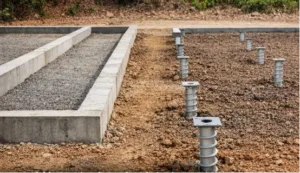
Ground Screws (Helical Piles)
Ground screws are steel piles installed directly into the soil, creating a fast and adjustable base.
They’re commonly used when:
•The terrain is uneven or soft
• Fast installation is required
• The project may be temporary or semi-permanent
Practical advantages:
•No concrete curing time
• Installation can often be completed in 1–2 days
• Easier to remove or adjust later
Limitations:
•Load capacity depends on soil conditions
• May require testing in very soft or sandy ground
For most projects, 76mm diameter screws with ~1200mm length are commonly used, with on-site load testing where needed.
In practice, the choice usually comes down to:
•Project duration
• Soil condition
• Installation speed requirements
There’s no universal solution — but choosing the right option early helps avoid most installation issues later.
Container House Installation Guide: Crane Access, Space Planning & Setup Requirements
One of the most underestimated parts of installation is space planning.
Expandable homes don’t just need space to sit —
they need space to be lifted, placed, and unfolded.
Crane Access and Lifting Clearance
Before delivery, make sure your site allows for:
• Crane positioning area
• Safe lifting radius
• Clear overhead space (no cables, trees, or other obstructions)
As a general reference:
• 40ft unit → ~6–8m clear width for crane operation
• 20ft/30ft unit → ~4–6m clear width
Ground bearing capacity also needs to support both the crane and unit load — this is one of the most commonly overlooked details in site planning.
Expansion Footprint: What Buyers Often Miss
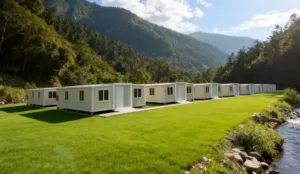
When folded, the unit is compact for transport.
But once expanded:
The footprint can nearly double in width
So your layout needs to consider:
• Final expanded dimensions of each unit
• Safe spacing between multiple units
• Maintenance access
• Drainage paths
A common mistake is planning the site layout based on shipping size, not the final operational size.
Simple rule:
Always design your layout based on the fully expanded footprint.
Plumbing and Electrical Connection Guide for Expandable Container Homes
Once the unit is placed, utilities are the next critical step.
This is where proper pre-planning can significantly reduce on-site work and delays.
Pre-Installed Systems: What “Plug-and-Play” Actually Means
All standard expandable units are delivered with:
•Pre-installed full internal wiring
• Integrated lighting and distribution box
• Pre-routed internal plumbing pipelines
This allows for relatively fast on-site setup.
But in practice,
“plug-and-play” still depends on your site being prepped correctly before delivery.
Water Supply and Drainage Planning
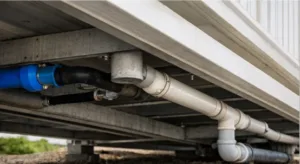
Before installation, confirm:
•Water inlet position (standard side or bottom connection on the unit)
• Drainage outlet alignment with your site’s piping system
• Proper slope for wastewater flow to avoid backups
If these points don’t match your site layout, adjustments will be needed after installation.
In many projects, drainage is one of the most underestimated factors affecting both installation speed and long-term durability — especially in coastal or high-rainfall environments. We’ve broken down the full drainage design and waterproofing system for expandable container homes in our dedicated guide.
Electrical Connection Setup
For power supply:
• Pre-route external cables to the unit’s distribution box
• Ensure voltage and amperage compatibility
• Allocate sufficient space for safe access and maintenance
In larger projects like worker camps, a centralized power distribution system is commonly used to connect multiple units efficiently.
In most cases, the smoothest installations are the ones where utilities are planned before delivery, not after.
Expandable Container House Installation Checklist (Site Preparation Guide)
Before the unit arrives, run through this simple checklist:
Ground & Foundation
Foundation fully completed (strip or ground screw)
Ground leveled and load-bearing capacity verified
Drainage paths prepared
Access & Space
Crane access route cleared
Expansion space reserved (based on unfolded size)
No overhead obstructions
Utilities
Water supply and drainage positioned
Electrical connection ready
Basic compatibility checked
Projects that follow this sequence often complete installation within a day.
Projects that don’t may run into:
• Installation delays
• Extra equipment costs
• On-site adjustments
Real Project Insight: Vanuatu Expandable Container Camp
In a coastal project in Vanuatu, we supplied 20+ double-wing expandable units for a remote infrastructure team.
The environment included:
• High year-round humidity
• Constant salt-laden coastal air
• Frequent heavy rainfall
The units were delivered ready for installation — but the site preparation was slightly behind schedule.
• Part of the strip foundation had not fully cured
• Drainage slope did not align with outlet positions
• Some crane access areas were still restricted
The result:
Installation was delayed by 4 full days
Not because of the product —
but because of incomplete site preparation.
A Practical Reality Check
Expandable homes are designed to simplify construction.
But they don’t remove the need for planning.
In most cases:
• Unit installation and expansion are typically completed within 2–4 hours under standard site conditions
• Full setup with utilities → ~1 day
Provided the site is properly prepared in advance
Final Thoughts
Installation usually isn’t where projects go wrong.
It’s the steps before the unit even arrives.
Foundation selection
Space planning
Utility alignment
These are small decisions early on —
but they tend to shape the entire installation timeline, cost, and long-term performance.
If you want to understand how structural design and material specifications affect long-term performance after installation, you can also check our detailed breakdown of expandable container house durability, steel frame structure, and sandwich panel specifications.
FAQ: Common Questions About Expandable Home Installation
1.How long does installation usually take?
The unit itself can often be placed and expanded within a few hours. The full timeline depends mainly on how ready the site is beforehand.
2.Which foundation is better: strip or ground screw?
It depends on the project. Strip foundations are often used for longer-term setups, while ground screws are more flexible for faster or temporary installations.
3.Do plumbing connections need to be prepared in advance?
Yes. Internal systems are pre-installed, but external connections should be ready to avoid delays.
4.How much space should be reserved?
Plan based on the fully expanded size of the unit, plus additional space for crane operation.
5.Can these units be installed on uneven ground?
Yes, typically with ground screw systems or additional leveling work.
6.Is electrical wiring included?
Internal wiring is usually pre-installed. External connections still need to be arranged on site.
Before You Start Your Project
If you’re planning an expandable container project, it’s worth reviewing your site conditions early.
Foundation, access, and utilities may seem like small details —
but they often determine whether installation takes a few hours… or several days.
A quick site plan check before production can prevent costly delays later. If you need a professional review of your site layout or custom foundation guidance, you can request a quick site layout review from our engineering team.