If you’re looking into an expandable container house office USA, the biggest hurdle usually isn’t design or budget—it’s getting past local building codes.

Ask anyone who’s tried to install a modular container office on US commercial land, and they’ll tell you the same thing:
It’s not the price.
It’s the permits.
You can have a solid layout, proper engineering, and a competitive quote—none of it matters if the local building department doesn’t approve it. The project stops there.
Unlike residential sheds or backyard offices, commercial modular spaces face strict, location-specific rules. There’s no shortcut. With decades of modular construction experience, many projects have shown that early compliance planning is what prevents costly delays later.
This guide walks through what actually matters for compliance—so your expandable container house office USA project moves forward instead of getting stuck.
What US Building Codes Apply to an Expandable Container House Office USA?
For commercial use, the International Building Code (IBC) is the baseline. Every state follows it, with local adjustments.
This is what determines whether your expandable container house office USA is approved, rejected, or delayed.
A common misconception is that container-based units are “pre-approved” because they’re factory-built.
They’re not.
The IBC includes a dedicated section—Section 3115—for intermodal containers used as buildings. This applies to any container office USA project used for commercial purposes.
Where things usually get complicated is at the local level.
A modular office unit that passes easily in Texas may face additional requirements in:
- Florida (hurricane wind loads)
- California (seismic compliance)
- Urban zones (zoning and setback limits)
Another detail many buyers miss:
Once installed, the unit is treated as a permanent commercial structure.
That means full compliance with:
- Foundation requirements
- Egress rules
- ADA accessibility
Transport flexibility doesn’t reduce regulatory responsibility—and this applies to every expandable container house office USA installation.
Container Office Permit USA: Structural & Safety Certifications You Need
For any container office permit USA process, certifications are not optional—they are the core of approval.
UL Fire Resistance Ratings
Most commercial applications require 1-hour or 2-hour fire ratings, depending on usage.
Inspectors will expect official UL documentation before moving forward. In practice, this approval depends directly on the quality and compliance of the fire-rated and structural materials used—material shortcuts often lead to failed inspections or rework.
To understand how material specs impact long-term compliance and durability, you can review our expandable container house material durability guide.
Wind and Seismic Engineering
Every expandable container house office USA must be engineered for its specific location.
That includes:
- Standard inland wind loads
- Hurricane-rated reinforcement (up to 180+ mph in coastal regions)
- Seismic compliance in western states
Without third-party engineering reports, many jurisdictions won’t even begin reviewing your application.
A simple example:
A unit installed in Florida may require reinforced anchoring for high wind zones, while the same structure in Ohio may only need standard structural support.
Same product—different compliance path.
Is a Container Office Legal in the US? Yes — With the Right Setup
This is one of the most common questions:
“Is a container office legal in the US?”
The short answer: yes—but only if it meets standard commercial building requirements.
A prefab office building becomes legal the same way any other commercial structure does:
By passing:
- Plan review
- Inspections
- Certification checks
There is no special exception for container-based structures.
You’ll still need:
- IBC-compliant engineering
- Fire-rated materials
- Proper foundation and anchoring
- ADA-compliant access
- Local zoning approval
Once those are in place, a compliant container office USA project is usually straightforward to approve.
Why Code-Compliant Modular Office Building USA Units Are Easier to Insure
Compliance doesn’t just affect permits—it also affects insurance.
Insurance providers evaluate risk based on structure predictability.
Non-certified units often face:
- Higher premiums
- Limited coverage
- Or outright rejection
In contrast, a fully compliant modular office building USA setup—with proper fire ratings and engineering—fits into standard commercial property insurance categories.
No special policy required.
This directly affects your long-term cost—not just upfront investment, but operational risk and financial stability over time for your expandable container house office USA.
Modular Office Building USA: Common Compliance Mistakes That Delay Permits
Most permit delays don’t come from the product itself.
They come from planning gaps.
Here are the most common ones:
1. Skipping Local Building Department Checks
IBC compliance alone isn’t enough.
Local authorities have the final say.
A quick pre-check can prevent major delays later—especially for an expandable container house office USA project.
2. Ignoring ADA Requirements
Commercial spaces must meet accessibility standards:
- Entry access
- Door widths
- Internal clearances
Missing this often leads to redesign after production.
3. Assuming All Units Meet US Standards
Many modular units are built for international markets and may not meet US commercial requirements.
If you’re evaluating different systems, it’s worth reviewing expandable container house office solutions to understand which configurations are designed specifically for US compliance.
4. Overlooking Foundation and Utility Requirements
Commercial installations require:
- Permanent foundations
- Code-compliant electrical systems
- Proper plumbing and HVAC integration
These are not secondary details—they are required for approval. Proper planning here can significantly reduce delays for any expandable container house office USA installation.
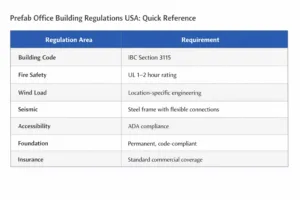
Prefab Office Building Regulations USA: Quick Reference
Here’s a simplified overview of key compliance requirements for US commercial container office projects:
Final Checklist Before You Commit
Before moving forward with an expandable container house office USA, it’s worth confirming a few key points:
- IBC compliance verified
- Fire rating documentation available
- Wind/seismic engineering confirmed
- Local code requirements checked
- ADA standards included
- Foundation plan defined
- Insurance eligibility confirmed
A well-prepared expandable container house office USA project doesn’t just pass inspection—it avoids delays, redesigns, and unexpected costs.
Final Thoughts
In US projects, success isn’t just about design or pricing.
It’s about whether your project gets approved—and how smoothly that process happens.
In many cases, the difference comes down to early decisions:
- Whether local codes were checked
- Whether engineering matched site conditions
- Whether compliance was considered from the start
Those choices often determine whether your expandable container house office USA moves forward in weeks… or gets held up for months.
If you’re planning a project and want to evaluate real-world configurations, specifications, and compliance-ready setups, you can explore our modular container office solutions.
And if you need help reviewing your project requirements, local codes, or engineering details, feel free to contact our team for practical guidance based on your project location.