For commercial property owners and contractors asking whether container prefab house buildings hold long-term value, the answer comes down to three things:
- How long they last
- How much they cost to maintain
- What happens to the asset when the project ends
It’s not just about lower upfront cost.
What really determines long-term value is how the asset performs across its full lifecycle.
This guide breaks down the real lifespan, maintenance savings, and resale potential of container prefab house systems—based on real-world US commercial use cases.
How Long Do Container Prefab House Buildings Actually Last?
A well-built container prefab house is not a short-term structure.
For commercial-grade units, the typical lifespan is:
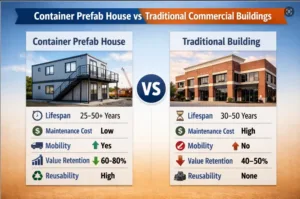
- 25–30 years baseline
- Up to 50+ years with proper corrosion protection and routine maintenance
That puts container prefab house buildings in the same range as many traditional steel-frame commercial structures.
The reason is simple:
Shipping containers were originally designed for extreme ocean conditions—saltwater exposure, heavy stacking, and constant movement.
When engineered properly for land-based applications, that durability carries over directly to commercial container prefab house buildings.
In practice, lifespan is less about the steel itself—and more about how well it’s protected.
What Affects the Lifespan of a Container Prefab House?
The biggest factor is corrosion.
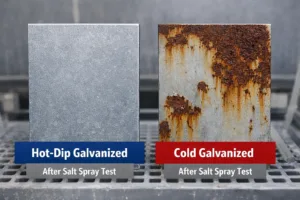
Steel doesn’t fail suddenly—it degrades over time. And in the US, climate plays a major role in how fast that happens.
High Humidity & Great Lakes Regions
Moisture, freeze–thaw cycles, and road salt all accelerate corrosion.
Most container prefab house systems in these regions use:
- Galvanized steel primer
- Epoxy intermediate coating
- Polyurethane topcoat
This creates a sealed barrier that slows corrosion and prevents internal moisture damage.
Desert & Southwest Climates
In places like Nevada or Arizona, corrosion isn’t the main issue—UV exposure and thermal stress are.
Temperature swings can exceed 40°F daily.
To handle this, high-quality container prefab house structures use:
- UV-resistant coatings
- Reflective exterior finishes
- Flexible sealants
This prevents cracking, warping, and long-term material fatigue.
Coastal & Hurricane Zones
Salt air is one of the most aggressive environments for steel.
For coastal container prefab house projects, protection typically includes:
- Zinc-rich marine primers
- Salt-resistant coatings
- Stainless steel fasteners
- Sealed structural joints
These specifications align with marine engineering standards, far exceeding the requirements of standard residential construction.
Maintenance Cost: Container Prefab House vs Traditional Buildings
For long-term asset holders, maintenance is where the real financial difference appears.
Based on recent US commercial construction benchmarks and industry estimates:
- Container prefab house buildings:$0.25–$0.45 / sq ft annually
- Traditional wood-frame buildings:$1.10–$1.80 / sq ft annually
That’s a 60–75% reduction in maintenance cost.
This is why the low maintenance cost of container prefab house units is one of the key drivers behind adoption in commercial projects.
Over a 20-Year Lifecycle
Traditional buildings often require:
- Full repainting every 5–7 years
- Pest control treatments
- Repairs for moisture damage or rot
In contrast, container prefab house units typically need:
- Occasional pressure washing
- Annual inspection of coatings and fasteners
- Minor surface touch-ups
No termites. No structural wood repairs.
For a 1,200 sq ft unit, that translates to $30,000–$50,000 in savings over 20 years.
Do Container Prefab House Buildings Have Resale Value?
This is where container prefab house buildings outperform traditional construction.
Traditional buildings are fixed assets.
When no longer needed, they’re often demolished—resulting in total loss.
A container prefab house, however, is:
- Modular
- Transportable
- Reusable
Industry data shows:
- Container prefab house buildings retain 60–80% value after 10 years
- Traditional buildings retain 40–50%
The difference comes from reusability.
Can Container Prefab House Units Be Relocated?
Yes—and this is one of their biggest advantages.
Especially for expandable designs, a container prefab house can be:
- Disassembled in 1–2 days
- Transported via flatbed
- Reinstalled within about a week
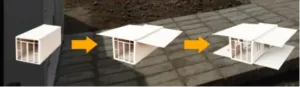
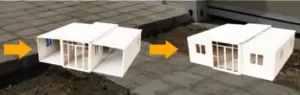
This makes them ideal for:
- Construction site offices
- Temporary commercial spaces
- Remote operations
Instead of rebuilding every time, the same container prefab house unit can be reused across multiple projects.
That transforms it from a one-time cost into a reusable asset.
Container Prefab House vs Traditional Commercial Buildings
So, Do Container Prefab House Buildings Hold Value?
In most US commercial scenarios, the answer is yes.
Not because they’re cheaper upfront—but because they behave differently as assets.
A container prefab house:
- Lasts as long as traditional steel buildings
- Costs significantly less to maintain
- Can be relocated and reused
- Retains stronger resale value
For investors and operators, this means:
- Lower total cost of ownership
- More stable returns
- Greater flexibility at project end
FAQ
1.Do container prefab house buildings depreciate faster?
No. In many cases, they depreciate more slowly due to reuse and resale potential.
2.How long does a container prefab house last?
25–30 years standard, up to 50+ years with proper protection.
3.Are container prefab house units a good investment?
Yes—especially for projects requiring flexibility, mobility, and lower operating costs.
4.Can container prefab house units be moved?
Yes. Most are designed for full relocation with minimal structural impact.
Final Thoughts
In commercial construction, long-term value isn’t defined at the time of purchase—it’s defined over the full lifecycle of the asset.
A container prefab house offers a fundamentally different model for commercial real estate. Instead of a fixed, location-bound structure that eventually becomes a write-off, it functions as movable, reusable infrastructure that continues delivering value across multiple projects and locations.
If you’re evaluating long-term commercial modular solutions, focusing on full lifecycle performance—not just upfront cost—is where container prefab house systems consistently stand out.
If you’re planning a US commercial project, you can contact our expert team to review your site conditions, compliance requirements, and cost expectations before you commit.