Introduction
Expandable container vs standard container office — at first, they look similar. Same steel, same factory build.
But run a real project, and the difference shows up fast.
One locks you into higher transport costs and fixed layouts.
The other gives you flexibility, faster setup, and lower total cost.
This isn’t just a product choice.
It’s a decision that affects how efficiently your project runs over time.
As we explain in our
container house ROI comparison guide the real question is always the same: which system performs better across the full project lifecycle?
This guide breaks that down in practical terms.
This expandable container office vs standard container office comparison focuses on real project ROI.
Expandable container vs standard container office comes down to three key differences:
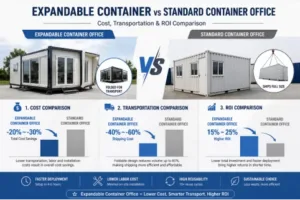
– Transport efficiency: Expandable units reduce shipping volume by up to 60%
– Deployment speed: Expandable units can be installed within hours
– ROI: Expandable systems typically deliver lower total project cost despite higher unit price
Expandable Container vs Standard Container Office: Structure and Limitations
A standard container office is built on a fixed steel frame, usually based on a 20ft or 40ft unit.
Once manufactured, the structure does not change.
What defines it:
- Fixed internal space (20ft ≈ 14m², 40ft ≈ 28m²)
- Delivered in full size
- Can be stacked up to 3–4 levels
- Minimal moving parts, simple structure
Where it works best:
- Long-term construction sites
- Permanent office setups
- Multi-story container buildings
- Projects with no relocation plans
In stable, long-duration projects, this simplicity is often an advantage.
Expandable Container vs Standard Container Office: Key Advantages
An expandable container office is designed differently from the start.
Instead of shipping at full size, it folds during transport and expands on-site.

This installation process is what enables faster deployment and better ROI in real projects.
Key features:
- 2.5–3x more usable space from the same shipping footprint
- Folded thickness around 2200mm for transport
- Setup time typically 4–6 hours
- Designed for repeated relocation and reuse
In practice, this changes how projects operate.
You’re not just installing a unit — you’re deploying space when and where it’s needed.
For more technical details, see our expandable container office solutions
Detailed Comparison of Expandable Container vs Standard Container Office
When comparing expandable container vs standard container office, the differences become clear once you look beyond unit price.
Here’s a visual breakdown of how expandable and standard container offices compare in real projects:
The Cost Gap Most Buyers Miss
A common mistake is focusing only on unit price.
On paper, a standard container looks cheaper.
But once transport and deployment are included, the numbers shift.
Example scenario:
- 10 standard units → ~5 full container shipments
- 4 expandable units → ~2 shipments
That difference alone can cut logistics costs by more than half.
For a typical overseas project (e.g., China to US West Coast), that can translate to tens of thousands of dollars in freight savings — often enough to offset the higher unit price of expandable units.
In international projects, this is frequently the deciding factor.
Estimates based on typical shipping routes and industry benchmarks. Actual savings vary by project location, volume, and current freight rates.
Best Use Scenarios for Expandable vs Standard Container Office
In real projects, choosing between expandable container vs standard container office depends on how your project behaves over time.
Choose Expandable Container Office if:
- The project duration is under 5 years
- You expect relocation
- Transport distance is long or international
- Fast deployment is critical
- You want to reduce unused or stranded assets
Typical use cases:
- Construction site offices
- Remote camps (mining, oil, infrastructure)
- Overseas engineering projects
- Emergency or temporary facilities
Choose Standard Container Office if:
- The project is long-term (5+ years)
- The structure will not be moved
- Multi-story stacking is required
- Budget is heavily constrained upfront
- Transport distance is short
Typical use cases:
- Factory offices
- Permanent institutional buildings
- Warehouse management offices
Expandable Container vs Standard Container Office: Pros and Cons
Expandable Container Office
Pros
- Larger usable space
- Typically 40–60% lower transport cost per m²
- Fast setup (4–6 hours)
- High reusability (10+ cycles)
Cons
- Higher unit price (15–25%)
- Slightly more complex structure
- Limited stacking height
Standard Container Office
Pros
- Lower upfront cost
- Simple, durable design
- Can be stacked 3–4 levels high
Cons
- Very limited internal space
- Higher transport cost per m²
- Slower deployment
Which One Should You Choose?
Ask yourself three questions. If you answer “yes” to any of them, expandable is likely the better choice.
- Will this office need to move later?
- Is transport distance significant (especially international)?
- How quickly does the site need to be operational?
If you answered “no” to all three — the project is fixed, local, and not time-sensitive — a standard container office may be sufficient.
For US-based projects, also remember that both systems must comply with local building codes. Learn more about
container office compliance requirements in the USA to avoid permit delays.
Frequently Asked Questions
1. Is an expandable container office more expensive?
Per unit, yes — typically 15–25% higher. But total project cost is often 15–30% lower due to savings in transport and installation.
2.Which one lasts longer?
Both are engineered for 20–30+ years with proper maintenance. Standard units have slightly fewer moving components, but expandable systems are designed for repeated relocation without structural degradation.
3. Can expandable units be stacked?
Yes, but usually up to 2 levels. For taller structures, standard containers are more suitable.
4.Are both customizable?
Yes. Layout, insulation, electrical systems, and interiors can all be tailored.
Final Thoughts
In real projects, the pattern is clear:
- If your project moves, needs speed, or crosses long distances → expandable container offices perform better
- If it’s permanent, local, and stackable → standard container offices may be enough
As project timelines shorten and logistics become more complex, more developers are prioritizing flexibility over fixed structures.
Need Help Choosing the Right Solution?
If you’re comparing expandable container vs standard container office for a real project, a simple quote is rarely enough.
You need to understand:
- Transport cost
- Deployment timeline
- Space efficiency
- Long-term reuse
Get your project cost breakdown and ROI estimate before you decide
Disclaimer
All figures and estimates in this guide are based on typical project scenarios and industry benchmarks. Actual results may vary depending on project location, shipping routes, order volume, customization, and other factors. Contact our team for a detailed assessment tailored to your specific project.
 Expandable Container Office Solutions: What Projects Actually Need Them in 2026?